We are interested in receiving new plays for review. Silk Moth is an unusual theater, and not every play is right for our context. But we love reading plays! We also are connected among theaters that produce new work. If your play isn’t right for us…maybe we’ll send it to a friend. You can email your scripts to hello@silkmothstage.com.
We are currently reading plays for our 2028 and ’29 seasons.
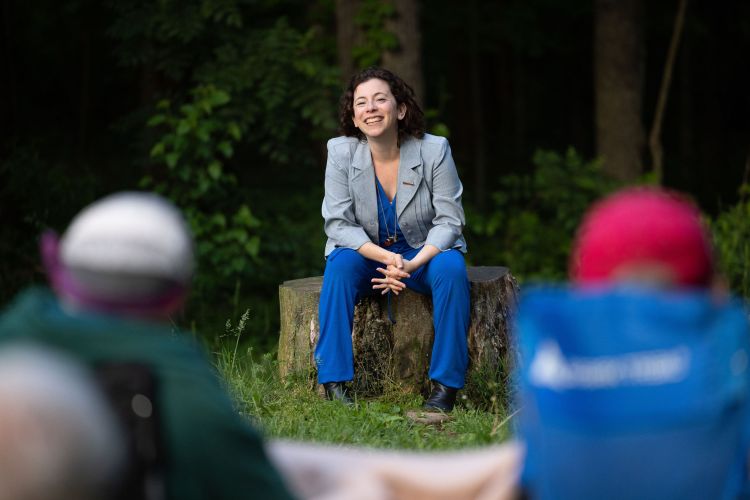
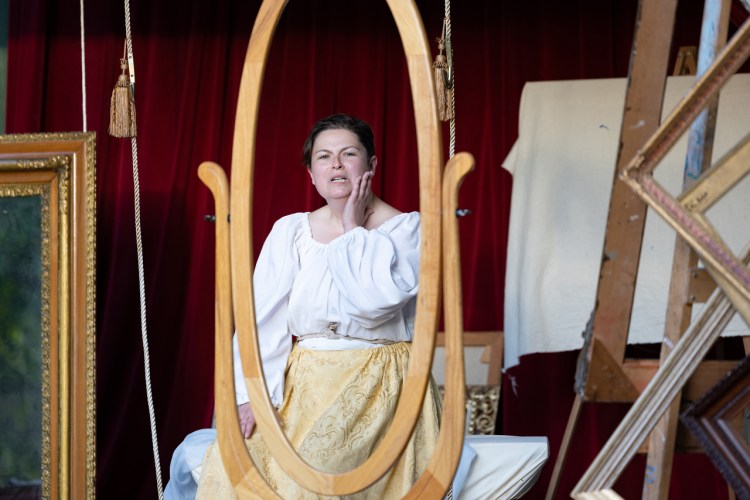
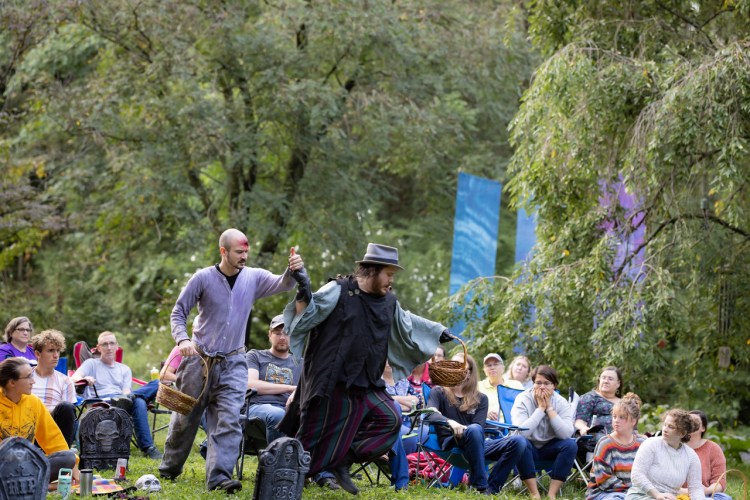
If you live near us, please come to a show; it might give you some idea of the type of theater we are able to do in this space. If you live farther off, please take some time to look through our production history at past show photos.
Silk Moth plays tend to have the following characteristics (but we are open to surprises):



- They are “new classics,” borrowing Shakespeare & Company’s definition of a “classic”: “The highest truths, universally told, with healing powers.” We’ve got some questions about which truths are the highest and whether a universal telling is possible, but we know we need those healing powers.
- They use minimal tech. Our stage is literally a porch on a house. We don’t have stage lights or projection; the sun is our illumination. Think carefully about scene transitions—we can’t do blackouts. We time plays to end at sundown (you can take advantage of this!). We prefer live-generated music and Foley sound. Our sets are minimal; there’s no fly system. We love practical magic.
- Plays don’t have to solve production problems for us! They just have to offer us the capacity to solve them. When we did Above Ground, by Ginna Hoben (2026), the script called for words to be projected, or displayed by some other means. This allowed us the latitude to figure it out ourselves.
- They have powerful language. We don’t do plays that sound like sitcoms. We love verse drama. We love carefully crafted rhetoric. We love words that feel like someone selected each one of them.
- They have audience connection. We’re big on meta theater. Our audience can see us, and we can see them seeing us. Our plays may or may not include direct address or audience interaction, but they always are aware of the audience’s presence.
- They explore challenging topics in a way that experiments with form. We’re not a didactic theater; we don’t do plays about an issue. We do plays where the “abouts” are core determiners of what unfolds, part of a bigger and more human story. Bonus points if the “abouts” are represented in surprising and innovative ways. “Tell the truth / but tell it slant,” if you know what we mean.
- A great example of this is Audrey Cefaly’s The Last Wide Open (2025). One of the central characters is an immigrant, and this is a crucial part of his story. But the problem he is trying to solve is that it’s so hard to tell somebody that you love them. The fact that he’s an immigrant doesn’t make this harder.
- They have small casts. For logistical and space reasons, we cannot produce a play that requires more than six actors. Our current budget allows us to hire, at most, eight actors per season (that’s eight actors across two plays). Also, a note on casting—we are far more likely to select plays that have casting that is flexible in terms of demographics.
- This doesn’t mean they have few characters, necessarily. The Grown-Up (2024), by Jordan Harrison, had at least a dozen different characters, but the script was structured in such a way that we could do it with six actors.
- They respond to place. This doesn’t mean that they’re set in the Shenandoah Valley. But they are in conversation with the landscape, the elements, and the community where we are situated.
- They contain a core message of hope and renewal. This doesn’t necessarily mean a happy ending. It just means we’re not nihilists.
- Even Human Museum (2026), by Miyoko Conley, which is literally about the end of humanity, managed to show what is beautiful and hopeful about humanity. It reminded us of what is worth saving.

